

Dormant Wallet Callback Scam: 7 Warning Signs Observed
ORIGINAL RESEARCH
Dormant Wallet Callback Scam: 7 Warning Signs You Should Never Ignore
Based on casework tracked since [2025] · Last updated [2026]
Across more than five cases we’ve investigated, we’ve identified a recurring pattern that follows a specific sequence: a victim loses money to an investment scam, the platform goes quiet, and then, weeks or months later, they receive an unsolicited call informing them that a cryptocurrency wallet exists in their name, holding a substantial balance they didn’t know about.
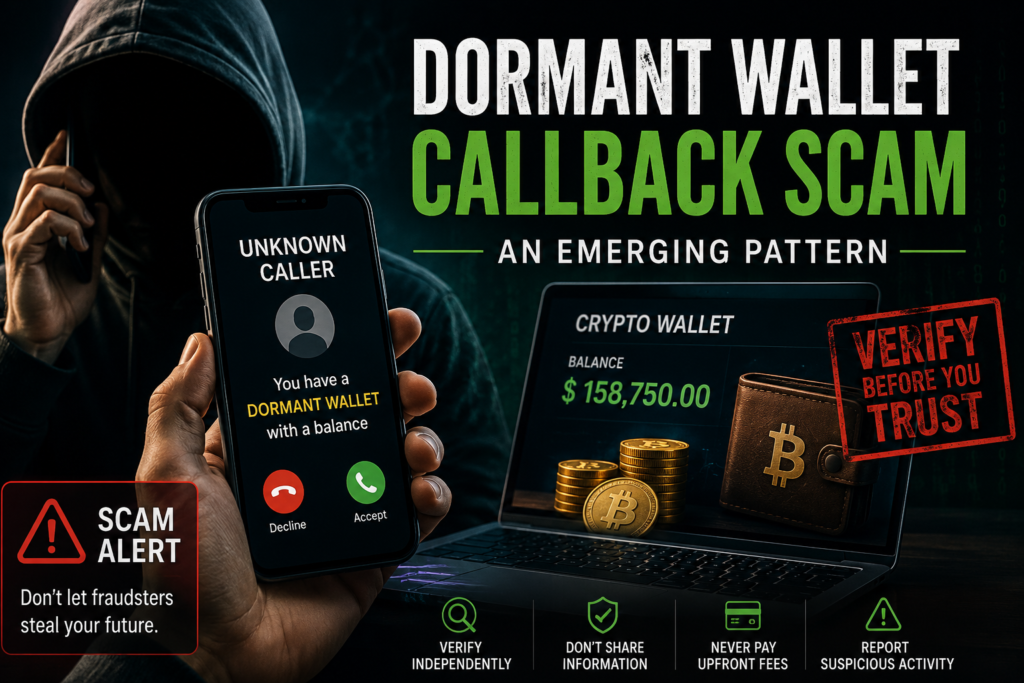
We’re calling this the dormant wallet callback scam. It’s distinct enough from generic “recovery scam” warnings to deserve its own analysis, because unlike most recovery scams, it doesn’t always ask for money upfront, which is what makes it more convincing, and more dangerous, than the pattern most warnings describe.
[rank_math_toc]
Could This Be a Dormant Wallet Callback Scam?
If someone has told you a wallet exists in your name, don’t act on it either way before it’s independently verified. We can check this properly.
Methodology
This analysis is based on direct casework rather than a formal statistical survey: patterns observed while investigating and, in some instances, resolving cases for our own clients. We’re publishing it because the dormant wallet callback scam has now recurred often enough, across cases with no connection to one another, that it’s clearly a method rather than a one-off. We’ll update this page as the pattern evolves or as we see it often enough to report harder numbers.
How the Pattern Unfolds
Stage 1 — The original loss
The victim has already lost money to an investment scam, often one matching the pattern in
How Investment Fraud Works
.
The platform stops responding or disappears entirely.
Stage 2 — The gap
Weeks or months pass with no contact. The victim has typically given up on recovering the original funds by this point.
Stage 3 — The callback
An unsolicited call or message arrives, claiming a cryptocurrency wallet exists in the victim’s name, holding a specific, often substantial, balance.
Stage 4 — The fork
From here the pattern splits one of two ways: either a request for an upfront “release” or “tax” payment follows quickly, the more familiar recovery-scam structure, or no payment is requested at all, and the victim is instead guided toward “verifying” the wallet through a channel the caller controls.
Why the Dormant Wallet Callback Scam Is More Dangerous Than a Standard Recovery Scam
Most recovery scam warnings focus on the upfront-fee structure because it’s the easiest red flag to identify: nobody legitimate asks for payment to release money that’s already yours. The dormant wallet callback scam is more dangerous precisely because it doesn’t always follow that structure. When no upfront payment is requested, the clearest warning sign many people expect simply isn’t there.
This also means the pattern doesn’t reliably fit the profile people have been told to watch for, which is exactly why it’s worth documenting as its own distinct fraud pattern rather than treating it as just another recovery scam.
Why It Works: The Psychology Behind It
The dormant wallet callback scam specifically targets people who have already lost money and have, in many cases, accepted that those funds are unlikely to return. The unexpected call reintroduces hope at precisely the moment a victim’s guard is lower. Fraudsters often present themselves as investigators, compliance officers, or recovery specialists, borrowing credibility through professional language and apparent expertise.
This emotional manipulation closely mirrors many of the behavioral techniques discussed in our Scam Psychology guide,
where authority, trust and perceived expertise are used to influence decision-making after an initial financial loss.
A Real Case
One case handled by our team followed this exact structure. After an investment platform stopped responding following a partial withdrawal, the client later received unsolicited calls claiming a cryptocurrency wallet containing a significant balance existed in their name.
Unlike the majority of similar reports, this particular claim proved to be genuine. The wallet was independently verified and the assets were successfully recovered. That outcome is unusual, not typical, which is precisely why every claim should be investigated on its own merits rather than accepted or dismissed without evidence.
You can read the complete investigation in our cryptocurrency recovery case study
.
How to Verify a Dormant Wallet Claim
Never verify a claimed wallet through any link, application or portal provided by the caller. Any verification should take place using a wallet application, exchange or blockchain tools that you access independently rather than through information supplied by the person contacting you.
If a wallet address is provided, its transaction history can usually be reviewed independently using a recognised blockchain explorer such as Blockchain.com Explorer.
The blockchain record itself can then be compared with the information supplied by the caller before any further action is taken. Our own guide on Cryptocurrency Wallet Tracing explains how investigators analyse wallet activity and transaction histories during scam investigations.
Treat any request for payment, regardless of how small or how it is described, as a significant warning sign. Genuine assets do not require an advance payment before they can be verified or accessed.
Frequently Asked Questions
Is the dormant wallet callback scam always a continuation of the original scam?
Not always. In the cases we’ve tracked, a dormant wallet callback scam is sometimes operated by the same group responsible for the original investment fraud and, in other instances, by a completely different organisation working from leaked or sold victim lists. Regardless of who makes the contact, the verification process should remain the same.
Could this ever be a genuine, forgotten wallet?
Although uncommon, it is possible. Genuine cryptocurrency wallets containing forgotten or inaccessible assets do occasionally exist. That is exactly why every claim should be independently verified rather than accepted automatically or dismissed without investigation.
What should I do if I’ve already engaged with a caller like this?
Stop communicating through the contact details provided by the caller and avoid making any payment. Preserve all emails, messages and documents, then verify the claim independently before taking any further action.
Not Sure If a Wallet Claim Is Real?
Independent verification is the only reliable way to know. If you’ve been contacted about a previously unknown cryptocurrency wallet, don’t rely on the caller’s information alone. Verify the claim before making any decisions or sending additional funds.