

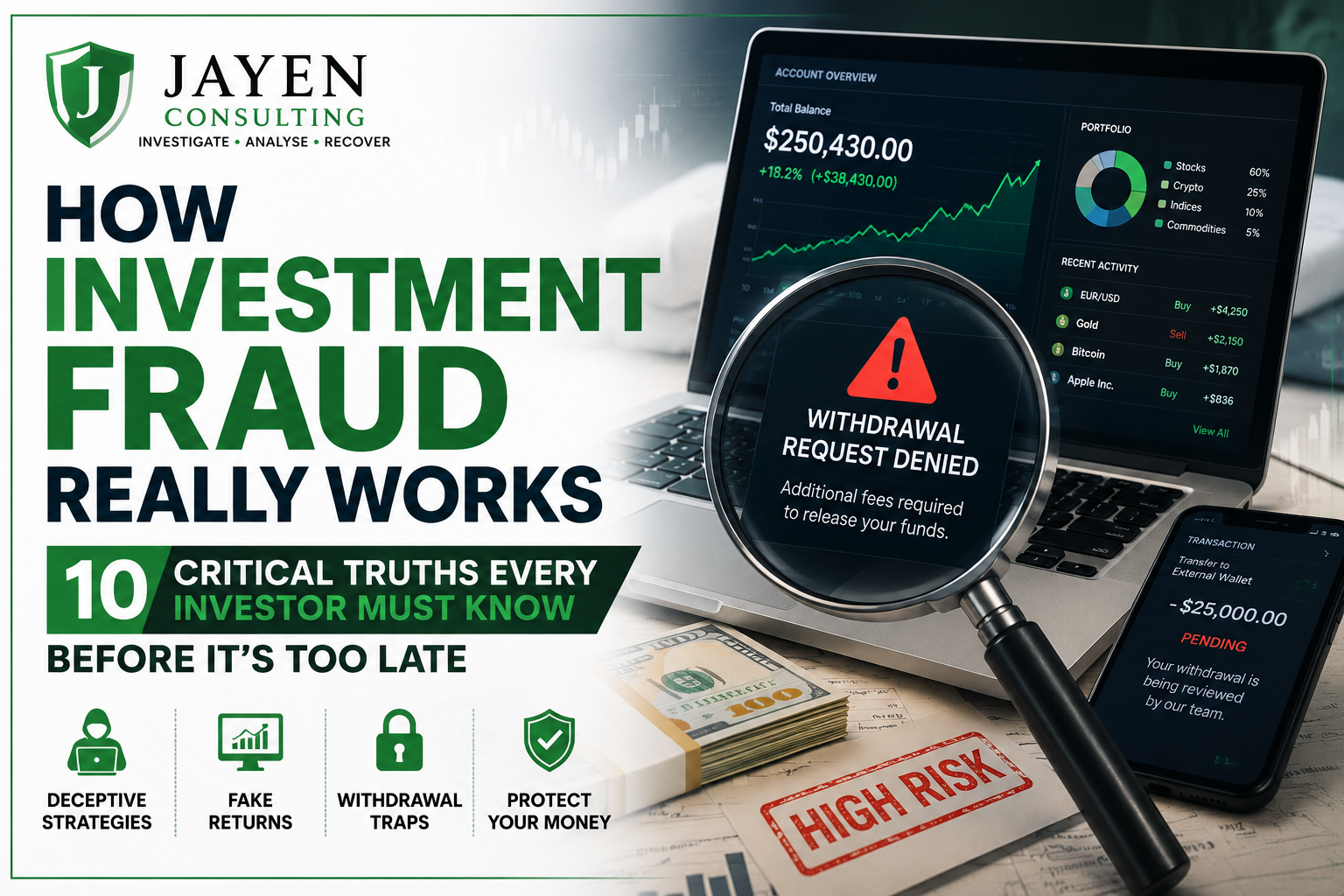
How Investment Fraud Really Works: 10 Critical Truths Every Investor Must Know Before It’s Too Late
Most investment scams don’t begin with obvious deception. They begin with trust. Modern fraud operations are designed to appear professional, credible, and financially sophisticated long before they ask victims to commit significant money.
Executive Summary
Investment fraud has evolved dramatically over the past decade. Instead of crude scams filled with spelling mistakes and unrealistic promises, many modern operations resemble legitimate financial businesses. They invest heavily in branding, customer service, trading dashboards, marketing campaigns, and persuasive sales teams.
By the time many victims begin questioning what is happening, they have already developed trust in the platform, formed relationships with account managers, and committed substantial funds.
This guide explains how investment fraud commonly works from beginning to end. Rather than focusing on one specific scam, it examines the recurring behavioral and operational patterns investigators frequently encounter across reported cases.
Understanding these patterns can help investors recognize warning signs much earlier and make informed decisions before significant financial losses occur.
Table of Contents
- The Hidden Architecture of Investment Fraud
- How Victims Are Selected
- The Trust Building Process
- Inside the Fake Investment Platform
- Financial Escalation
- Withdrawal Manipulation
- Evidence Every Victim Should Preserve
- Practical Safety Checklist
- Frequently Asked Questions
- Professional Scam Assessment
1. The Hidden Architecture of Investment Fraud
Many people imagine investment fraud as a single scammer operating behind a laptop. In reality, many reported cases suggest organized operations involving multiple individuals performing specialized roles.
One person may focus exclusively on attracting new investors, another may handle onboarding, while separate teams manage customer support, payment instructions, technical platforms, and withdrawal requests.
This division of responsibility creates the appearance of a legitimate financial company. Victims often interact with several different representatives, making the organization appear larger and more trustworthy than it actually is.
From an investigative perspective, this structure also reduces suspicion. Every conversation appears professional because each participant performs a specific function within the overall operation.
The result is a carefully managed customer experience designed to increase confidence while gradually reducing independent verification.
Internal Resource:
[[Internal Link: Anatomy of High-Risk Investment Platforms]]
2. How Victims Are Selected
Investment fraud rarely begins with an immediate request for money. Instead, operators often spend considerable time identifying individuals who are likely to remain engaged.
Many reported cases begin through social media advertising, messaging applications, investment discussion groups, dating platforms, or unsolicited telephone calls.
The initial objective is simple: start a conversation.
Rather than selling an investment immediately, many fraudsters begin by discussing financial markets, cryptocurrency, retirement planning, or wealth creation. These conversations establish familiarity before any financial opportunity is introduced.
A common investigative observation is that responsiveness matters more than wealth. People who consistently reply, ask questions, or engage in conversation are often prioritised because they demonstrate trust and willingness to communicate.
The longer communication continues, the stronger the relationship becomes.
This gradual progression often makes later investment requests feel natural rather than suspicious.
3. How Fraudsters Build Trust Before Asking for Money
Trust is the foundation of almost every successful investment fraud scheme.
Instead of demanding immediate deposits, many operators spend days or even weeks developing credibility. They may share financial news, explain market movements, discuss investment strategies, or introduce seemingly successful clients.
Some victims report being added to investment discussion groups where other members appear enthusiastic about their profits. These environments can create powerful social proof, even though participants may not be genuine investors.
Professional websites, polished documentation, responsive customer support, and impressive trading dashboards further reinforce the perception of legitimacy.
None of these features, however, confirm that investments are actually being executed.
A professional appearance should always be treated as the beginning of due diligence—not the end of it.
For independent guidance on recognising investment scams, review the public resources provided by the UK’s Financial Conduct Authority through its ScamSmart initiative before committing funds to any investment opportunity.
4. Inside the Controlled Investment Platform
Once trust has been established, investors are usually introduced to an online platform where they can monitor account balances, portfolio performance, and apparent trading activity.
These dashboards often look remarkably convincing. Charts move in real time, balances increase steadily, and completed trades appear throughout the day.
However, appearance alone cannot confirm that genuine market activity is taking place.
Investigators frequently examine whether displayed transactions correspond to independently verifiable market activity. In many reported cases, victims later discover that the information presented inside the platform could not be confirmed externally.
This distinction is extremely important.
A sophisticated dashboard demonstrates software development—not necessarily legitimate investing.
Learning how to separate presentation from genuine financial activity is one of the most valuable skills any investor can develop.
5. Financial Escalation: Why the First Deposit Is Rarely the Goal
One of the biggest misconceptions about investment fraud is that criminals are primarily interested in securing a single payment. In many reported cases, the initial deposit represents only the beginning of a carefully managed financial escalation process.
Victims are frequently encouraged to start with a relatively small investment. This lowers psychological resistance while allowing the platform to demonstrate apparent returns. If early profits appear on the dashboard—or if a small withdrawal is processed successfully—it reinforces confidence and increases the likelihood of larger future deposits.
Investigators often refer to this as progressive commitment. Rather than asking for £50,000 immediately, operators gradually encourage larger investments over weeks or months, using previous “success” as evidence that the system works.
Many reported victims describe hearing statements such as:
- “You’re in at the perfect time.”
- “Your account qualifies for a premium investment tier.”
- “Larger balances unlock higher returns.”
- “Professional investors are increasing their positions.”
These messages are designed to create confidence, urgency, and fear of missing an opportunity rather than encourage objective financial analysis.
6. Withdrawal Requests Often Reveal the True Nature of the Platform
For many victims, the first indication that something is wrong occurs when they attempt to withdraw money.
Up until this point, communication may have been responsive, professional, and reassuring. Once withdrawal requests begin, however, the experience frequently changes.
Across many reported cases, investigators repeatedly encounter similar explanations:
- Additional identity verification is required.
- Tax or government charges must be paid before funds are released.
- Compliance departments require further documentation.
- Processing fees must be paid in advance.
- The account needs upgrading before withdrawals are available.
None of these explanations automatically indicate fraud. Legitimate financial institutions also perform compliance checks and identity verification. The concern arises when new conditions continue appearing each time previous requirements have been satisfied.
A recurring pattern in reported cases is the introduction of fresh financial demands shortly before an expected withdrawal. Investors should approach any request to send additional money in order to release existing funds with extreme caution.
Concerned About an Investment Platform?
If you are experiencing delayed withdrawals, unexpected fees, or changing account conditions, an independent review may help identify whether your case shows patterns commonly reported in investment fraud investigations.
Early assessment can help you preserve evidence, understand your options, and avoid making additional payments before obtaining independent advice.
7. Early Warning Signs Most Investors Miss
Many victims later describe warning signs that seemed insignificant at the time but became obvious in hindsight. Modern investment fraud rarely begins with blatant deception. Instead, it often develops through a sequence of small inconsistencies that become increasingly difficult to ignore.
Learning to recognise these indicators early can significantly reduce financial exposure and may prevent larger losses.
High-Risk Warning Indicators
- Pressure to invest before completing independent research.
- Guaranteed returns or claims of “risk-free” investments.
- Withdrawal requests becoming increasingly difficult.
- Unexpected taxes or release fees before funds can be accessed.
- Communication moving away from official company channels.
- Requests to keep investments confidential.
- Difficulty verifying company registration or ownership.
- Constant encouragement to increase deposits despite concerns.
- Websites containing copied legal documents or vague regulatory claims.
- Customer support that suddenly becomes inconsistent after withdrawal requests.
None of these indicators alone confirms fraud. However, when multiple warning signs appear together, the overall risk increases substantially and warrants careful investigation.
8. Investment Fraud Evidence Checklist
If you suspect you may have invested through a fraudulent platform, preserving evidence immediately is one of the most important steps you can take.
| Evidence | Why It Matters |
|---|---|
| Email communications | Shows promises, instructions and timelines. |
| Chat messages | Documents conversations with representatives. |
| Bank transfer receipts | Helps establish payment history. |
| Crypto wallet transactions | Supports blockchain tracing where appropriate. |
| Dashboard screenshots | Records displayed balances before they disappear. |
| Withdrawal requests | Shows delays, refusals and changing explanations. |
| Identity documents submitted | Helps determine potential identity misuse. |
Avoid deleting conversations, emails or account screenshots. Even information that appears insignificant may become valuable during a professional review.
Need Help Investigating Your Case?
If you’re experiencing withdrawal problems, unexplained account restrictions or suspect you’ve become the victim of investment fraud, our investigation team can review your case confidentially.
9. Frequently Asked Questions
Are all investment platforms fraudulent?
No. Many legitimate investment firms operate under recognized regulatory frameworks. The key is verifying their registration, ownership, transparency and regulatory status independently before investing.
Why do some scam platforms allow small withdrawals?
Many reported cases suggest that small withdrawals are sometimes permitted early in the relationship to increase confidence and encourage substantially larger deposits later.
Can professional-looking websites still be fraudulent?
Yes. Website quality is not evidence of legitimacy. Fraudulent operations often invest heavily in design, branding and user experience because visual credibility encourages trust.
Should I pay additional fees to release my investment?
If unexpected taxes, insurance fees, verification payments or release charges appear only after requesting a withdrawal, proceed with extreme caution and independently verify every request before sending additional funds.
What should I do first if I believe I have been targeted?
Stop making further payments, preserve every piece of communication, record transaction details, and seek an independent review before taking further action.
| Authority | Purpose | URL |
|---|---|---|
| Financial Conduct Authority (FCA) | UK Financial Regulator | https://www.fca.org.uk/scamsmart |
| Action Fraud UK | UK National Fraud Reporting Centre | https://www.actionfraud.police.uk |
| National Cyber Security Centre (NCSC) | UK Cyber Security | https://www.ncsc.gov.uk |
| U.S. Securities and Exchange Commission (SEC) | US Securities Regulator | https://www.sec.gov |
| FINRA | Broker & Investment Verification | https://www.finra.org |
| Commodity Futures Trading Commission (CFTC) | Commodities & Forex Regulation | https://www.cftc.gov |
| Internet Crime Complaint Center (IC3) | FBI Internet Crime Reporting | https://www.ic3.gov |
| Europol | European Financial Crime | https://www.europol.europa.eu |
| Australian Securities & Investments Commission (ASIC) | Australia Financial Regulator | https://asic.gov.au |
| Canadian Anti-Fraud Centre (CAFC) | Canada Fraud Reporting | https://antifraudcentre-centreantifraude.ca |
| Monetary Authority of Singapore (MAS) | Singapore Financial Regulator | https://www.mas.gov.sg |
| Swiss Financial Market Supervisory Authority (FINMA) | Switzerland Financial Regulator | https://www.finma.ch/en |
| Cyprus Securities and Exchange Commission (CySEC) | Cyprus Investment Regulation | https://www.cysec.gov.cy |
| European Securities and Markets Authority (ESMA) | European Financial Markets Regulator | https://www.esma.europa.eu |
| International Organization of Securities Commissions (IOSCO) | Global Securities Regulators | https://www.iosco.org |
Investigative Insight
Investment fraud succeeds because it is carefully engineered to imitate legitimate financial services while gradually manipulating trust, confidence and decision-making. The technology used may change, but the underlying strategy remains remarkably consistent across many reported cases.
The most effective defence is not simply recognising one warning sign—it is understanding the complete fraud lifecycle. By recognising how trust is built, how deposits are escalated and how withdrawals are controlled, investors are better positioned to identify problems before significant financial losses occur.
Every investment opportunity deserves independent verification. Professional websites, persuasive representatives and impressive dashboards should never replace proper due diligence.
If something feels inconsistent, investigate before investing.